

What results modern laser treatments deliver
Most people want the same thing from laser hair removal: less hair, less often, with fewer ingrowns.
In a standard series, that’s realistic. A 2025 clinical paper reported about 75% hair reduction at six months across treated areas, with regrowth that tends to come back thinner and lighter.
Ready to start? Book your laser hair removal appointment here
Here’s the timeline most Thompson’s Station clients can plan around. Laser hair removal is usually 6 to 8 sessions, spaced 4 to 8 weeks apart. Underarms and bikini often respond faster. Legs, backs, and hormonal areas (chin, neck) usually need the full series.
Expect a pattern.
After sessions 1-2, hair sheds in 1-3 weeks, then returns patchy. By sessions 3-4, results look “real” in photos and in the shower. By sessions 6-8, you’re mostly maintaining.
Maintenance is normal. Many people do touch-ups every 6-12 months because follicles can wake up over time.
One honest limitation: not all hair can be treated well. Your Fitzpatrick skin type, hair color, hormones, tanning, and meds all change results. Light blonde, red, and gray hair respond poorly, and no device fixes that.
How laser hair removal works — devices, sessions, and safety for local skin types
Why does it take multiple visits?
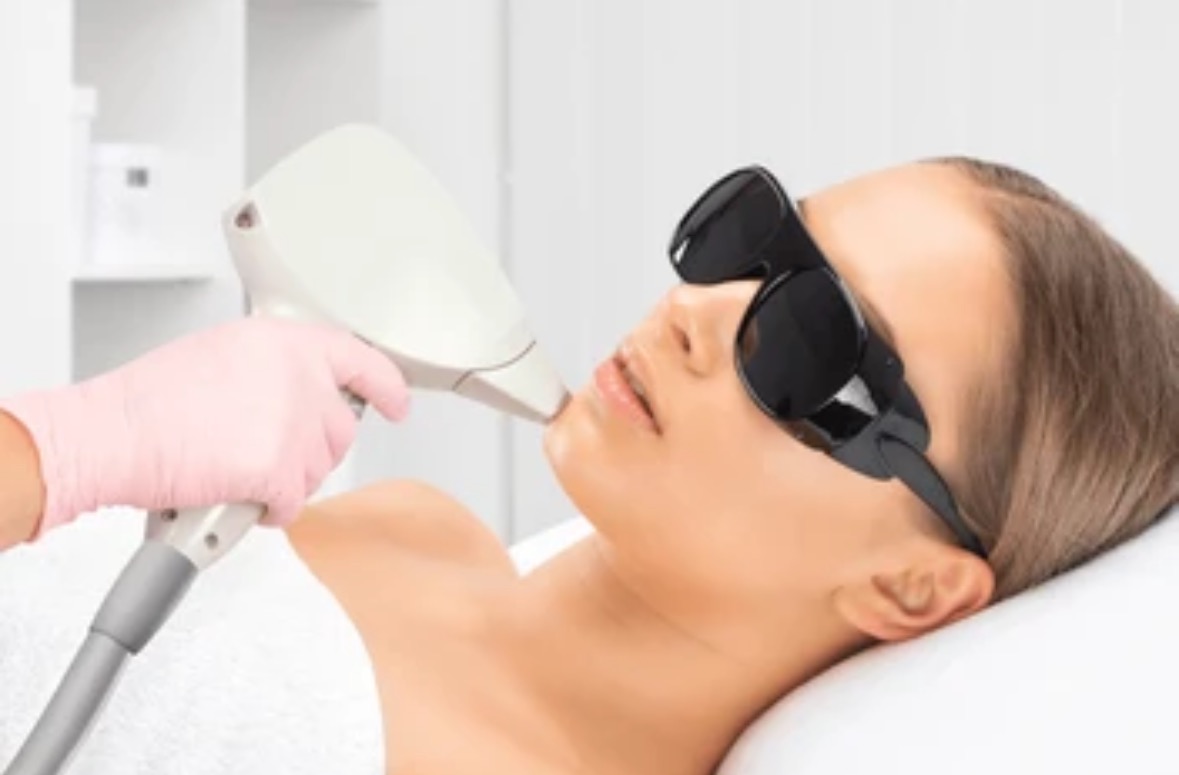
Laser hair removal targets pigment (color) in the hair root with light energy. That heat damages the follicle so it can’t grow a strong hair again. The technical term is “selective photothermolysis,” which means “heat the target, spare nearby skin.”
Timing is the catch. Hair responds best in the active growth phase, so you need multiple sessions to catch different hairs at the right moment (see the basics in this clinical overview).
Devices you’ll see around Nashville, and what they’re best at
Different lasers use different wavelengths (types of light). That choice affects both results and safety, especially for deeper skin tones.
| Device type | Best fit (typical) | Why it’s chosen | Watch-outs |
|---|---|---|---|
| Alexandrite | Fitzpatrick I, III | Fast, strong on dark hair and lighter skin | Higher burn risk on tanned or deeper skin |
| Diode laser | Fitzpatrick II, IV (sometimes V) | Good balance of speed, comfort, and results | Needs careful settings on IV, V |
| Nd:YAG | Fitzpatrick IV, VI | Safest option for deeper skin tones | Often takes more sessions, can feel “spicier” |
If you’re Fitzpatrick IV, VI (olive to deep brown skin), ask directly what device they’ll use and why. For many clients, Nd:YAG is the safer play.
What a good treatment pathway looks like
A solid plan is boring. That’s a compliment.
- Consultation with a real provider (MD, RN, or trained laser clinician under medical oversight). They should review meds, sun exposure, pregnancy status, and history of pigment issues.
- Test patch on higher-risk areas (face, bikini, or deeper skin tones).
- Series schedule every 4-8 weeks, adjusted by area.
- Aftercare focused on calming skin and protecting your skin barrier: gentle cleanser, bland moisturizer, and strict SPF daily.
Downtime is usually minimal. Most people have 1-24 hours of redness and “goosebump” swelling around follicles. You can work the same day, but skip hot yoga, saunas, and heavy workouts for 24-48 hours.
Safety checks that actually matter
Ask who’s operating the laser and what training they’ve. “Technician” can mean anything. In this region, it’s common to see an RN or clinician working with a medical director, but they should still be able to explain settings, risks, and what they’ll do if you blister.
Common side effects are redness, swelling, and temporary darkening or lightening of skin. The biggest preventable risks come from recent tanning, wrong settings for your Fitzpatrick skin type, and poor aftercare.
A quick real-world example: a new client once came in after a weekend on the lake with “just a little color.” We rescheduled. It was inconvenient, but it likely prevented a burn and a months-long pigment issue.
If you’re also doing microneedling, collagen-stimulating treatments, or PDRN injections, space them out so your skin isn’t inflamed on treatment day. If you’re rebuilding your routine for the season, our spring skincare routine guide helps you keep products simple while your skin settles.
One more practical note: IPL isn’t the same as a laser. If you’re comparing options, this trial listing shows how researchers split IPL versus diode outcomes, and why device choice matters.
Key Takeaways
- Expect noticeable reduction after 6-8 sessions spaced 4-8 weeks apart, then plan periodic maintenance touch-ups.
- Match device to your Fitzpatrick skin type: alexandrite for lighter tones, Nd:YAG for deeper tones, diode is versatile.
- Choose laser hair removal providers who offer consults, test patches, and clear aftercare, and verify MD, RN, or technician credentials.
- At Skn Shack, ask about device selection, package pricing, add-ons like numbing, and what visible results to expect.
- Pick Skn Shack for local boutique continuity and follow-ups, or Nashville clinics for volume pricing and broader specialist access.
- Book around your schedule and season, follow shave rules, and plan travel, parking, and return visits before starting.
Skn Shack in Thompson’s Station: technology, pricing, and real local outcomes
Device choice matters more than most people think.
The settings have to match your skin tone, hair thickness, and even how tan you get between sessions. Laser energy targets pigment in the hair, so the goal is enough heat to disable the follicle without stressing your skin barrier. A 2025 paper reported about 75% hair reduction at six months in treated areas, with thinner regrowth over time (clinical outcomes).
At Skn Shack in Thompson’s Station, we build plans around that reality, not a one-size menu.
Here’s what that looks like in practice: a client treating underarms and bikini may see faster “quiet time” between shaves by visit three, while chin/neck hair often needs more patience and tighter spacing. Same person, same device family, different biology.
If you’re also doing microneedling for collagen support or using newer regeneratives like PDRN, we time things so your skin isn’t doing “too much” at once. That keeps irritation and downtime low.
Pricing and packages
Most clinics price by area and charge per visit, then discount with a package. Here’s the common structure we use locally:
| Item | What it covers | Typical notes |
|---|---|---|
| Per-session pricing | One body area, one visit | Best for small areas or trial runs |
| Packages | 6-8 sessions for one area | Usually the best value for coarse hair |
| Touch-ups | Maintenance after your series | Often 1-2 times per year |
| Add-ons | Numbing, extra areas, upgraded timing | Numbing isn’t always needed, but it can help for bikini/upper lip |
| Consult | Skin + hair review, plan, rules | Often credited toward treatment |
If you want to see the full menu, most clients start by scanning our treatments and then we narrow it down in consult.
The clinical process
Expect a quick consult plus a safety checklist: meds (especially isotretinoin history), recent sun exposure, cold sores if we’re treating the face, and any history of pigment issues.
We’ll confirm you’re using SPF daily because tanning raises burn risk and can slow your schedule.
Next is a test patch when it’s needed, then your first full treatment. You’ll usually see shedding at 7-21 days, then smoother “quiet” time before the next cycle. Most people notice visible reduction around sessions 3-4, with best results after 6-8.
Pro-tips for booking
Shave 12-24 hours before. Don’t wax or pluck for 3-4 weeks. Bring loose clothes for bikini/legs.
Fall through early spring is prime time, less sun, easier aftercare.
If you’re driving in from Spring Hill or Franklin, book follow-ups before you leave so you stay on-cycle.
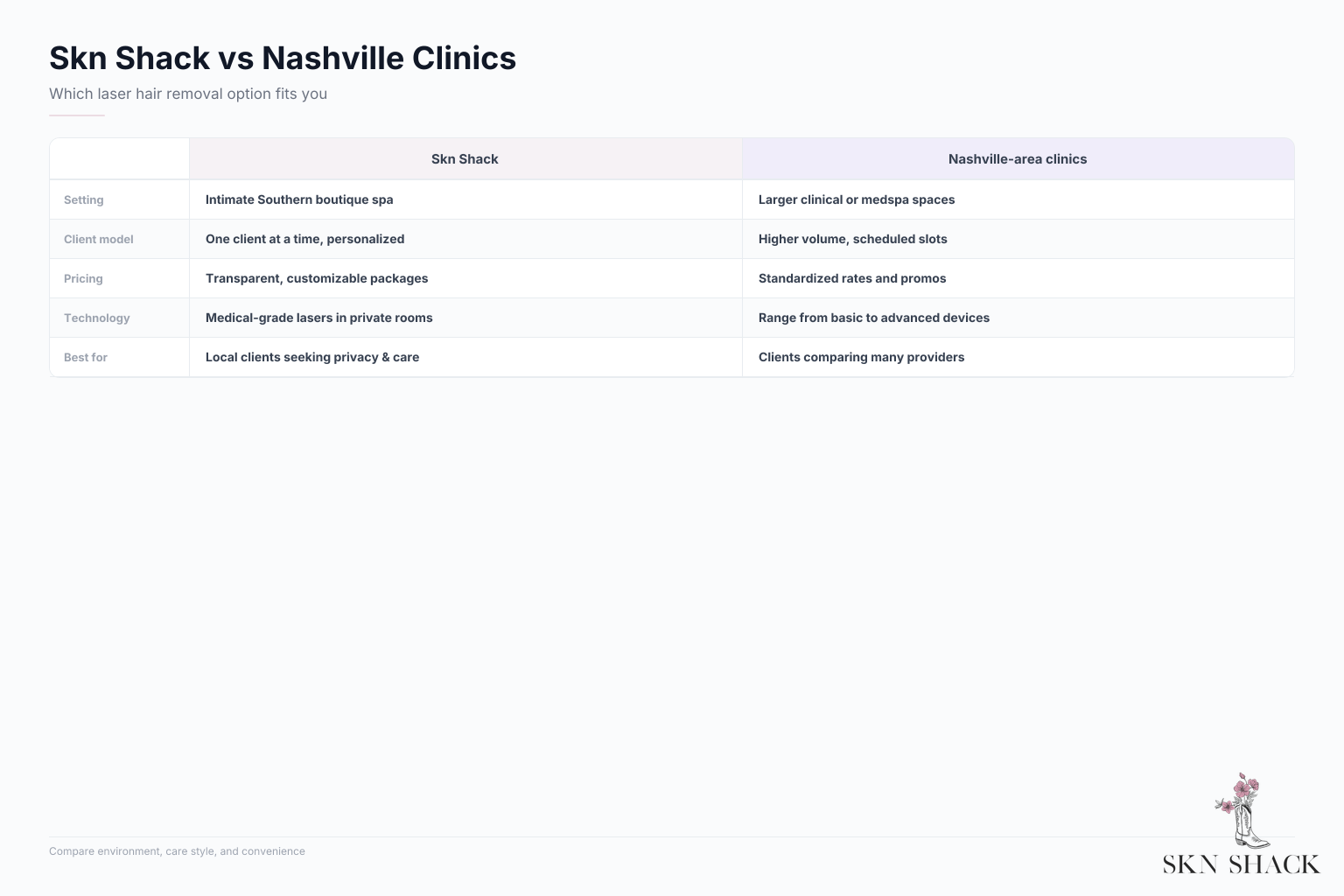
Comparing Skn Shack to Nashville-area clinics — who should choose which option
If two places both offer hair reduction, what actually changes your result?
Consistency beats hype. The best outcomes come from the right device, the right provider, and a schedule you can keep. Hair reduction is real, but it’s rarely “forever” without maintenance (clinical overview).
Side-by-side decision factors
| Factor | Skn Shack (Thompson’s Station) | Nashville clinics |
|---|---|---|
| Experience style | Boutique, same small team | More rotating staff, higher volume |
| Follow-up | Easier to pop in for checks | Great systems, but less flexible |
| Cost | Competitive, package-based | Wider range, sometimes bigger promos |
| Travel/time | Short drive, easier parking | More traffic, longer round trips |
| Options | Tight, curated menu | More devices and specialty services |
Who should pick which option
Pick Skn Shack if you want a local plan, continuity, and tighter oversight between visits. It’s also a strong fit if you’re balancing other skin work (like microneedling or PDRN) and want one team coordinating timing and aftercare.
A larger Nashville medspa can make sense if you’re chasing volume discounts, need very extended hours, or want access to a deeper bench of specialty MD-led services. Research output in this field keeps growing, but the practical takeaway hasn’t changed: matching settings to skin and hair is the whole game (research trends).
Quick decision checklist
- Budget: can you commit to 6-8 sessions plus touch-ups?
- Skin tone: do you tan easily (and will you wear SPF daily)?
- Body area: coarse hair needs more visits.
- Pain tolerance: ask about cooling and numbing options.
- Schedule: can you return every 4-8 weeks without skipping?
Seasonally, book fall/winter if you’re outdoors a lot in Tennessee summers. It makes the rules easier to follow and keeps your timeline on track.
Frequently Asked Questions
How many laser hair removal sessions will I need?
Most people need 6 to 8 laser hair removal sessions spaced about 4 to 8 weeks apart. That schedule typically delivers around a 60 to 80% reduction, since hair grows in cycles and the laser works best during the active growth phase. Your exact number can vary based on hair color, skin type, hormones, and the area you’re treating. Many clients also choose occasional maintenance sessions to keep results consistent.
Is laser hair removal safe for darker skin tones?
Yes, laser hair removal can be safe for darker skin tones when the right technology and settings are used. Modern Nd:YAG lasers and some diode platforms are commonly used for Fitzpatrick IV to VI because they can better target the follicle while minimizing risk to surrounding skin. At your consult, ask about a test patch, the device being used, and how they adjust settings for your skin type. Choosing trained staff matters.
How does Skn Shack’s pricing compare to Nashville medspas?
Skn Shack typically offers boutique pricing with package discounts and more personalized follow-up. You’ll often get more continuity in who treats you and how your plan is adjusted session to session, which can be helpful if your hair growth pattern changes. Larger Nashville medspas may run lower per-session promotions or flash sales, but you might see different providers and have less consistent tracking. Ask for total package cost, not just a single-session rate.
What should I do to prepare for a laser session?
To prepare, avoid tanning, stop waxing or electrolysis for 4 to 6 weeks, and shave the area about 24 hours before your appointment. Laser hair removal targets the follicle, so the root needs to be present, but surface hair can increase irritation. You should also disclose medications and skincare products, especially retinoids or photosensitizing meds, since they can affect sensitivity. Bring a quick list of past hair removal methods and any recent treatments to your consult.
References
- “Laser Hair Removal – StatPearls – NCBI Bookshelf” — ncbi.nlm.nih.gov — https://www.ncbi.nlm.nih.gov/books/NBK507861/
- “Medical laser hair removal: a new rotational approach – PMC” — pmc.ncbi.nlm.nih.gov — https://pmc.ncbi.nlm.nih.gov/articles/PMC12364753/
- “Hair Removal: Intense Pulsed Light Versus Diode Laser” — clinicaltrials.gov — https://clinicaltrials.gov/study/NCT06179186
- “Analyzing global research trends and focal points of laser hair .” — link.springer.com — https://link.springer.com/article/10.1007/s10103-024-04123-x
- “Laser Hair Removal | Cosmetic and Plastic Services” — ohsu.edu — https://www.ohsu.edu/cosmetic-plastics-services/laser-hair-removal
- “Laser Hair Removal Homepage” — tdlr.texas.gov — https://www.tdlr.texas.gov/las/
- “Laser Hair Removal, Columbus, Ohio” — wexnermedical.osu.edu — https://wexnermedical.osu.edu/aesthetics/non-surgical-procedures/laser-hair-removal
- “Patient-reported outcomes of laser hair removal for .” — doi.org — https://doi.org/10.1007/s10103-026-04893-6
- “Laser hair removal” — en.wikipedia.org — https://en.wikipedia.org/wiki/Laser_hair_removal
- “Best Laser Hair Removal Devices 2026” — forbes.com — https://www.forbes.com/sites/forbes-personal-shopper/article/best-laser-hair-removal-devices/